

The Enduring Spirit of the Hadzabe: Life Among Tanzania’s Last Hunter-Gatherers
In the rugged landscapes surrounding Lake Eyasi in northern Tanzania’s Arusha Region, a small community continues one of humanity’s oldest ways of living. The Hadzabe (also known as Hadza or Wahadzabe in Swahili) are among the last true hunter-gatherer societies in Africa — and indeed the world. With a total population of roughly 1,200–1,500 people, only a few hundred still live primarily by foraging and hunting in the bush. Their story is one of remarkable resilience, deep ecological knowledge, radical egalitarianism, and an intimate relationship with the land that has sustained them for thousands of years.
Ancient Roots in the Rift Valley
The Hadzabe are widely regarded as descendants of Tanzania’s original hunter-gatherer populations, predating the arrival of Bantu farmers, Cushitic herders, and Nilotic pastoralists. Their language, Hadzane, is a linguistic isolate — unrelated to any other known language on Earth — despite featuring distinctive click consonants that once led linguists to mistakenly group it with southern African Khoisan languages. Genetically, the Hadzabe also stand apart, with no close living relatives, though some admixture with neighboring groups has occurred over millennia.
For most of human history, this mobile, foraging lifestyle was the norm. The Hadzabe offer a living window into that deep past — not as “primitive” relics, but as a contemporary people whose traditions, knowledge, and social structures have adapted while retaining core elements.
Life in Motion: Camps, Seasons, and Daily Rhythms
Hadzabe life is organized around small, flexible camps of 20–30 people. These camps move frequently — sometimes every few weeks — following the availability of water, game, honey, and wild plants. Shelters are simple and quick to build: frameworks of branches covered with grass or leaves. In the dry season, people often sleep under trees or in rocky overhangs.
desertislandsurvival.comuniteafricafoundation.org
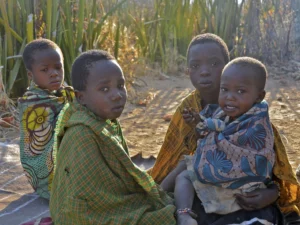
Daily life follows the sun and the seasons. Mornings often begin with hunting parties heading out at dawn. Women and children gather tubers, berries, baobab fruit, and greens using digging sticks and woven baskets. The work is not back-breaking; studies show Hadzabe adults typically spend only 3–4 hours a day on subsistence activities, leaving ample time for rest, storytelling, socializing, and play.
The diet is diverse and seasonal:
Wet season: Heavy on honey, fruit, tubers, and occasional meat.
Dry season: More meat as animals concentrate near water sources.
Honey is especially prized — providing up to 10–20% of calories at times. The Hadzabe have a remarkable mutualistic relationship with the greater honeyguide bird, which leads them to wild beehives. They harvest sustainably, often using smoke, and are famous for their fearlessness around bees, sometimes eating honeycomb still buzzing with activity.
hadzabe.orgvisitnatives.com
The Art of the Hunt
Hunting is central to Hadzabe identity, skill, and social life. Men (and occasionally women) use handmade bows and arrows crafted from local woods and reeds. For larger game they apply poison derived from the Adenium coetaneum plant. Prey includes impala, dik-dik, kudu, baboons, warthogs, bush pigs, birds, and smaller animals. Nothing is wasted; meat is shared widely according to custom, with the hunter often receiving the skin as recognition.
Tracking skills are extraordinary — reading footprints, broken twigs, sounds, and even the emotional state of animals. Hunting success also carries social prestige through the epeme system: men who kill large game earn special status and ritual privileges.
alamy.comHadzabe, Hadza traditional ethnic hunting tribe Tanzania Tanzania Collection Stock Photo – Alamy
A Society Without Chiefs or Hierarchies
One of the most striking features of Hadzabe culture is its radical egalitarianism. There are no formal chiefs, inherited leadership, or centralized authority. Decisions are made by consensus. Camps are fluid — people move freely between groups to resolve conflicts or follow personal preferences. Sharing is not optional; hoarding or refusing to share food is socially unacceptable.
Gender roles exist (men primarily hunt, women primarily gather), but they are flexible and complementary rather than rigidly hierarchical. Childcare is communal. Marriage is usually monogamous but not strictly enforced, and descent is bilateral. This social structure fosters cooperation, reduces conflict, and ensures resilience in a demanding environment.
Language, Stories, and Spiritual Life
Hadzane is spoken fluently by most Hadzabe and remains a vital marker of identity, though it is classified as vulnerable by UNESCO because its use is largely confined to the home and community. The language is rich in expressive particles and verb forms that convey direction, time, and nuance.
Spirituality is deeply tied to the natural world rather than formalized religion. The sun (Ishoko) and moon (Haine) hold special significance. Ancestors are believed to influence daily life. The most important ritual is the epeme dance, performed in near-darkness at the new moon. Men dance while women sing; it reinforces social bonds, manhood, and harmony between the living and the spirit world. There are also coming-of-age practices and a rich oral tradition of stories featuring culture heroes, giants, and explanations of the natural order.
Pressures of the Modern World
The Hadzabe face serious challenges. Their ancestral lands have shrunk dramatically due to agricultural expansion by neighboring groups (particularly Datooga pastoralists and Isanzu farmers), who clear bush for crops and grazing, destroying tubers, berries, and wildlife corridors. Tourism brings income but can also bring cultural commodification and alcohol-related problems when cash enters the economy suddenly.
Past government attempts to settle the Hadzabe and introduce farming often failed, sometimes with tragic consequences from disease. Today, many Hadzabe live hybrid lives — some have small gardens, iron-roofed houses, or smartphones, while still spending significant time in the bush. A portion have moved into tourism or conservation work.
Yet there are also hopeful developments. Through partnerships with organizations like the Ujamaa Community Resource Team and The Nature Conservancy, the Hadzabe have secured legal title to tens of thousands of acres via Certificates of Customary Right of Occupancy. Carbon credit and conservation projects now generate income for community needs while protecting forests. These efforts recognize that the Hadzabe’s light ecological footprint and deep environmental knowledge are assets worth preserving.
The Enduring Spirit of the Hadzabe: Life Among Tanzania’s Last Hunter-Gatherers
Why Their Story Matters
The Hadzabe are not frozen in time. They are a living, adapting culture whose values — radical sharing, consensus decision-making, profound ecological literacy, and freedom of movement — offer powerful lessons for a world facing inequality, environmental crisis, and social fragmentation.
Their continued presence in the Tanzanian landscape reminds us that there are many valid ways to be human. Supporting their land rights, respecting their choices about how much (or how little) modernity they embrace, and learning from their sustainable relationship with nature benefits not only the Hadzabe but all of us.
Whether encountered through ethical, community-led tourism experiences near Lake Eyasi or through supporting conservation initiatives, time with the Hadzabe offers something rare: a direct connection to the deep rhythms of human existence and a living example of resilience in the face of change.
The Hadzabe continue to walk lightly on the land their ancestors have known for millennia — hunting at dawn, gathering honey in the heat of the day, sharing stories around the fire, and moving with the seasons. Their story is still being written, and it deserves to be heard with respect and clarity.